
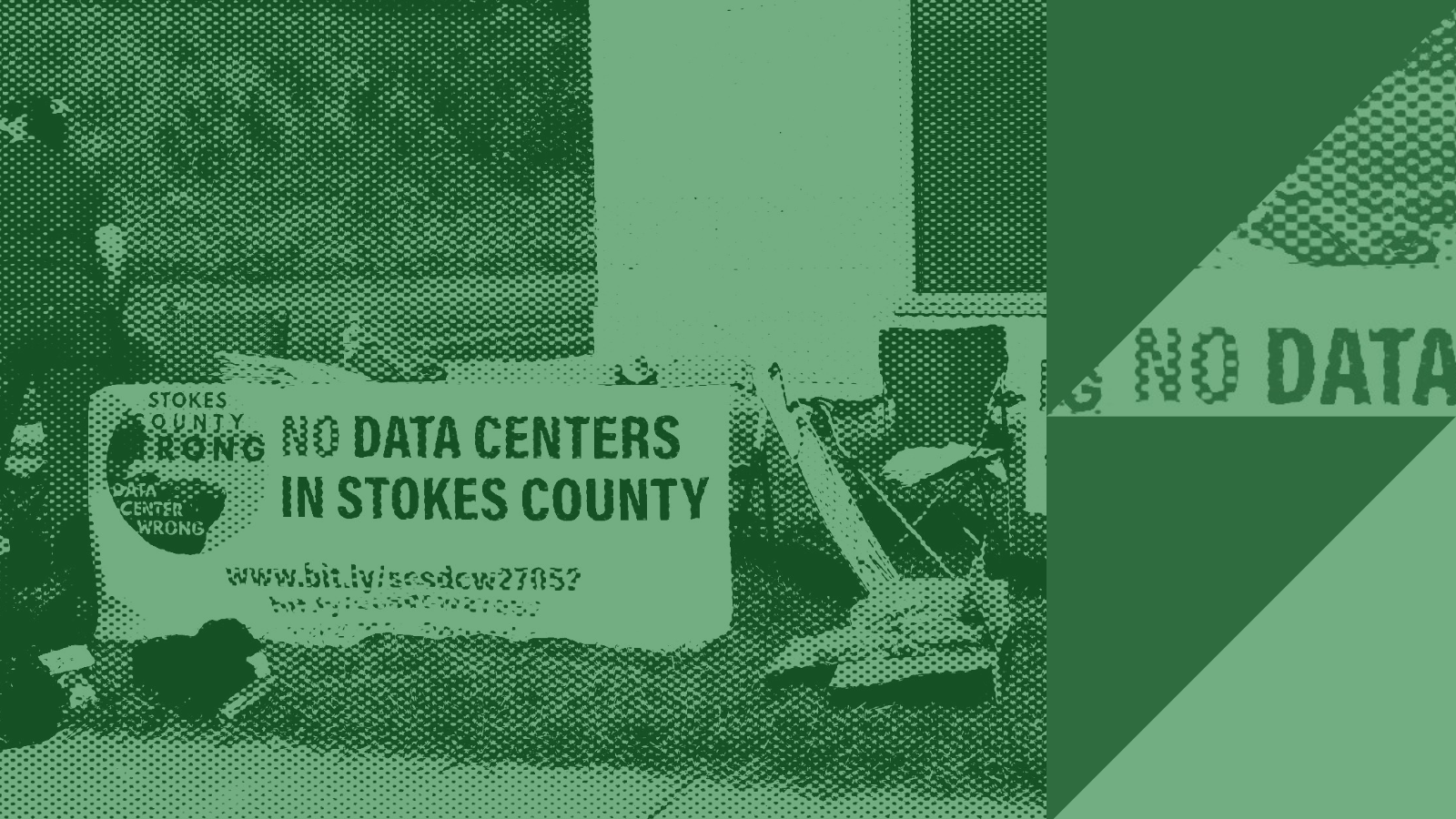
DANBURY, N.C. (Nov. 13, 2026) — For the second time this year, Walnut Cove area residents and community groups are asking a court to stop Stokes County from turning nearly 1,850 acres of farmland, forest, archaeological sites, and cemeteries along the Dan River into one of the country’s largest AI data center campuses.
Southern Coalition for Social Justice (SCSJ) and the Southern Environmental Law Center (SELC) filed a lawsuit Thursday in Stokes County Superior Court on behalf of 16 individual plaintiffs and four community organizations challenging the Board of Commissioners’ 3-2 vote on Sept. 14 to rezone the land for the speculative “Project Delta.”
This is the second lawsuit over the project. In April, the county voided its first rezoning after many of the same plaintiffs sued over a flawed process. The new lawsuit alleges the county rebuilt its second approval on a rushed and deficient analysis that appears to have been generated by artificial intelligence without being independently verified. It asks the court to void the rezoning and block the county from relying on or implementing it.
“We chose this place for the peace and quiet, and that’s exactly what this rezoning puts at risk,” said Rachel Dillon, a plaintiff whose property sits directly next to the site. “We’re already seeing more trucks on our road from another nearby project. Now the county wants to put one of the biggest data centers in the country next door, without answering basic questions. We’re asking the county to follow the law and listen to the people who live here.”
Commissioners approved the rezoning against their own Planning Board’s recommendation and against overwhelming community opposition at every step. Their vote came during a drought, after the county manager warned them three days earlier that Danbury was “nearly out of water,” according to the lawsuit. Their approval came without a confirmed water source, without limits on on-site power generation, and without a complete survey of the property’s graves and archaeological sites.
“Stokes County fixed its paperwork, not its problems,” said Anne Harvey David, Chief Counsel for Environmental Justice at SCSJ. “Commissioners approved one of the largest industrial rezonings in county history without knowing where the water will come from, how power will be generated, or what lies in the ground. And in their rush to approve this project before the next Board of Commissioners is seated, they seem to have relied on an AI analysis to give pro forma justification for the decision. But the law requires a reasoned decision, made by people, on the real facts. Stokes County residents deserve nothing less.”
Seventeen months before Project Delta, the Board of Commissioners denied a request to rezone much of the same land for a solar farm. They found it would take away agricultural land and the county’s “natural beauty.”
The county is now set to vote in less than two weeks, on Nov. 23, on a 15-year development agreement for Project Delta, which has “a larger footprint and a more intensive industrial district” than the solar project. According to the lawsuit, the agreement would lock in the rezoning’s shortcomings, exempt the property from any future data center moratorium, and commit the county to help defend the developer’s interests against challenges from its own residents.
“For decades, southeastern Stokes County has absorbed pollution from Duke Energy’s coal plant and its coal ash waste,” said Megan Kimball, senior attorney with the Southern Environmental Law Center. “Residents of this area, including the families of the County’s historic Black communities, and the American Indian people whose ancestors are buried along the Dan River, deserved a full and honest look at what one more industrial project would cost them and the river. Instead, they got a rushed vote on a speculative proposal and a record full of errors, and that’s why we’re in court now.”
The land holds some of the most significant archaeological sites in North Carolina. These include Saura village sites where University of North Carolina archaeologists recovered the remains of more than 150 people, as well as a mapped cemetery of about 65 graves believed to hold the remains of people enslaved on the Hairston plantation. The Catawba Indian Nation told commissioners that several of the sites are culturally affiliated with the Nation and that it had not been consulted. In a September letter to the board, local historians and archaeologists warned: “To be crystal clear: numerous human remains are still in the ground.”
“Twice now, Stokes County has failed the descendants of the people who lived and labored on this land, and it has failed those still buried here,” said Lawrence Bethea, President of National Hairston Clan. “Many of the graves out there are unmarked, tucked into the wooded patches scattered across these fields. Hairston descendants and Indigenous families have a right to visit and commune with their ancestors. The county voted to industrialize this land without even fully surveying where they rest.”
The Stokes County community has adamantly opposed the data center development, nearly unanimously. In the county’s own random-sample survey, residents named the data center as their top concern more than any other issue, and as the biggest threat to their quality of life, according to the lawsuit. Many cited the county’s rural setting as why they live there. The county’s staff reports never mentioned the survey.
“The best way to not have input from local citizens is to have some hurry-up county commissioners,” said Tim Mabe, a county resident and lawsuit plaintiff. “Next, you need a developer that will tell you anything you want to hear.”
The individual plaintiffs are Tabatha and Timothy Ashburn, David Beane and Lori Miller, Rachel Dillon and her son Bryce Dillon, Tim and Deborah Mabe, Roger Richer and his daughter Jessica Richer, Ashleigh and Parker Tuttle, Terry and Barbara Woodcock, and Bruce and Tina Younts; and the organizational plaintiffs are the National Hairston Clan, CleanAIRE NC, the Dan River Basin Association, 7 Directions of Service.
###
Southern Coalition for Social Justice came together in 2007 to give Black, Brown, and low-income people better resources in the fight for justice across the South. We are lawyers, social scientists, and communications professionals working to dismantle racism and oppression in the criminal legal system, in our environment, and at the ballot box. Learn more at southerncoalition.org and follow our work on Facebook, Instagram, YouTube, and LinkedIn.
The Southern Environmental Law Center is one of the nation’s most powerful defenders of the environment, rooted in the South. With a long track record, SELC takes on the toughest environmental challenges in court, in government, and in our communities to protect our region’s air, water, climate, wildlife, lands, and people. Nonprofit and nonpartisan, the organization has a staff of 250, including more than 160 legal and policy experts and advocates, and is headquartered in Charlottesville, VA, with offices in Asheville, Atlanta, Birmingham, Chapel Hill, Charleston, Nashville, Richmond, and Washington, DC. Learn more at selc.org.