
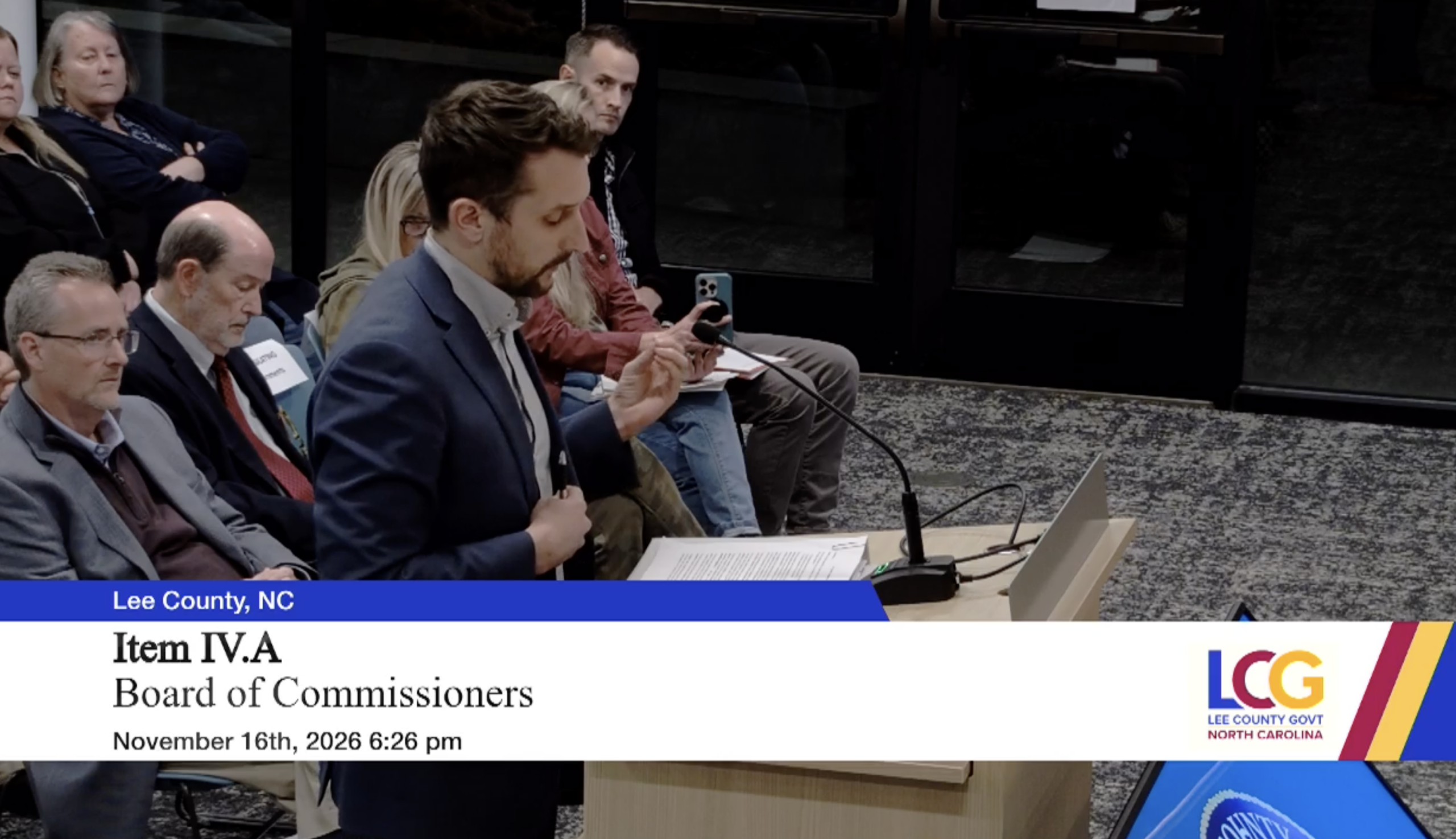
SANFORD, N.C. (Nov. 18, 2026) — Lee County commissioners voted unanimously Monday night to re-approve the county’s development ordinance, including an amendment allowing large data centers to be built on any industrial land in the county without projects being subjected to a hearing or vote from elected officials.
Sanford City Council members voted 3-3 on the development ordinance data center amendment, requiring the mayor to cast a tie-breaking vote for approval. The town of Broadway’s Board of Commissioners is scheduled to consider the matter Nov. 23. Southern Coalition for Social Justice (SCSJ) sent all three governments a letter on behalf of the Blue Ridge Environmental Defense League and Clean Water for North Carolina and spoke during the public comment periods for both Lee County and the City of Sanford.
Cliff Robins, Senior Counsel for Environmental Justice at SCSJ, said a text amendment about data centers incorporated into the development ordinance was never legally adopted. The amendment was first passed earlier this year and allows data centers by right on land zoned light or heavy industrial. It also set disappointing, minimal limits on noise and water use and does not differentiate between size or type of data centers.
“Hyperscale AI data center technology is brand new, rapidly developing, and its impacts are largely unknown,” the letter states. “It is therefore incumbent upon local governments to be especially diligent and circumspect in authorizing these types of industrial users within their jurisdictions.”
State law requires local governments enacting zoning changes to adopt statements evaluating whether the change is consistent with the locality’s comprehensive land-use plan, and local ordinances require similar statements on whether the change is reasonable and in the public interest. On Nov. 9, Lee County’s zoning administrator acknowledged the county has long gone without adopting consistency statements for zoning text amendments, and planning board materials for Lee County, Sanford, and Broadway reflected the same gap. This deficiency impacts the 2026 data center ordinance, which all three governments passed.
The letter notes that, because the data center amendment was never valid, the governments are free to adopt a moratorium to slow the process, allowing time for further research and work toward stronger protections.
At Monday’s meeting, the county’s attorney acknowledged that the site plan and permit for the Lower Moncure Road data center has been appealed to the Lee County Board of Adjustment. Also, if the jurisdictions do not act to fix the issues with their development ordinance, the data center amendment remains open to legal challenge, which could leave the county without data center rules at all. Many residents attended both nights of back-to-back public hearings and expressed concern for their communities, especially around noise impacts.
At the Sanford City Council meeting, Mayor Pro Tem Byron Buckels and Council members Walter Ferguson and Chris Petty cast the three dissenting votes. Buckels and Ferguson both agreed with residents’ concerns about the potential noise impacts of data centers on the community.
“We are disappointed that Lee County and Sanford chose to re-approve data center rules that were not lawfully adopted earlier this year,” said Robins. “They both had the opportunity to slow this process down with a moratorium and deliberate on more effective protections for their community. Unfortunately, their majorities chose not to do that. I hope Lee County follows through with their promise to adopt more protective data center regulations in January and that Sanford joins them in that effort.”
Residents say a roughly 430-acre site on Lower Moncure Road was described as a business park before it was announced as a $900 million data center. Nearly 3,000 people have signed a petition for a moratorium, and about 150 spoke against the project at a July meeting. The county approved the building permit on Sept. 25 and voted 5-2 on Oct. 5 against a moratorium. Neighbors have appealed the permit to the Board of Adjustment.
###
Southern Coalition for Social Justice came together in 2007 to give Black, Brown, and low-income people better resources in the fight for justice across the South. We are lawyers, social scientists, and communications professionals working to dismantle racism and oppression in the criminal legal system, in our environment, and at the ballot box. Learn more at southerncoalition.org and follow our work on Facebook, Instagram, YouTube, and LinkedIn.