REFRAMING PUBLIC SAFETY
Reducing Recidivism and Improving Public Safety
The Problem
While not every contact with the criminal legal system involves incarceration, far too many do. Yet, even after someone has fully paid their debts to society and been released from jail or prison, they will often find themselves facing barriers and stigma. This is not an isolated issue. Roughly 600,000 people leave prisons across the country each year; in North Carolina, approximately 18,000 people return to their communities each year after completing their prison sentences. Approximately 9 million people are released from jails nationwide, with more than 380,000 leaving North Carolina’s 63 county jails.
Individuals who have been incarcerated face significant challenges trying to re-integrate into their communities and rebuild their lives. Involvement with the criminal legal system can, among other things, limit access to employment, housing, healthcare, public benefits, and education.
Recognizing that these challenges exist, mitigating their harms, and ultimately eliminating these consequences would reduce recidivism and improve public safety, creating a system focused on rehabilitation rather than punishment.
The Solutions
On January 29, 2024, North Carolina Governor Roy Cooper signed Executive Order No. 303, which requires state agencies to help make the re-entry process more accessible and to combat recidivism. As part of Executive Order 303, Gov. Cooper created the North Carolina Joint Reentry Council, consisting of representatives from all state cabinet agencies, to improve rehabilitation and reentry efforts statewide. On August 7, 2024, the Council approved a strategic plan to guide North Carolina reentry efforts through 2030. Additionally, North Carolina joined Reentry2030, a national initiative to improve the re-entry success of all formerly incarcerated people.
North Carolina is one of the few states that partially or permanently denies people access to SNAP benefits or food stamps because of a felony conviction. Denying access to SNAP benefits increases the likelihood of poverty, addiction, and recidivism. Removing this ban would improve food accessibility for vulnerable communities across the state.
Many people involved in the criminal legal system live on the economic margins. The economic cost of interacting with the criminal legal system can quickly add up to thousands of dollars, but people often don’t have the financial ability to pay. Unpaid legal fees can lead to an arrest warrant, incarceration, the loss of public benefits, suspension of driver’s license, and negative credit rating. North Carolina courts should waive or reduce criminal financial obligations, rather than converting them into civil judgments, creating long-lasting debt.
North Carolina is among the remaining states that automatically suspend a motorist’s driving privilege for failure to pay a traffic ticket. Not having a driver’s license creates significant barriers for individuals who were formerly incarcerated, affecting their housing, employment, and voting. North Carolina should increase driver’s license restoration for debt-based suspensions. (For information about our lawsuit to end the practice of revoking licenses for failure to pay fines and court costs, click here.)
Many individuals lack health insurance upon release from incarceration, making it challenging for them to manage their healthcare needs without it. All eligible individuals should have the opportunity to apply for Medicaid before release.
Approximately one in six people released from North Carolina prisons in 2023 were unhoused. Last year, 3,000 out of the 18,000 people released from North Carolina prisons were unhoused. Individuals who experience homelessness after incarceration are more likely to re-engage with the criminal legal system again. North Carolina should create systems to help individuals find homes before their release and housing authorities should evaluate housing applicants as individuals rather than excluding them because of their criminal record.
Individuals with criminal records encounter barriers to obtaining gainful employment. Approximately 1.6 million people in North Carolina have a criminal record. Meaningful employment reduces the risk of recidivism. Employers must be informed about the financial incentives available to them as second-chance employers.
Mugshot photos can show someone at one of their lowest moments. Yet the images are regularly made available by law enforcement agencies to media outlets and private companies. The continued circulation of mugshots can impact returning citizens’ job opportunities, housing, and reputation. The availability and use of mugshot photos should be regulated.
Internal Resources
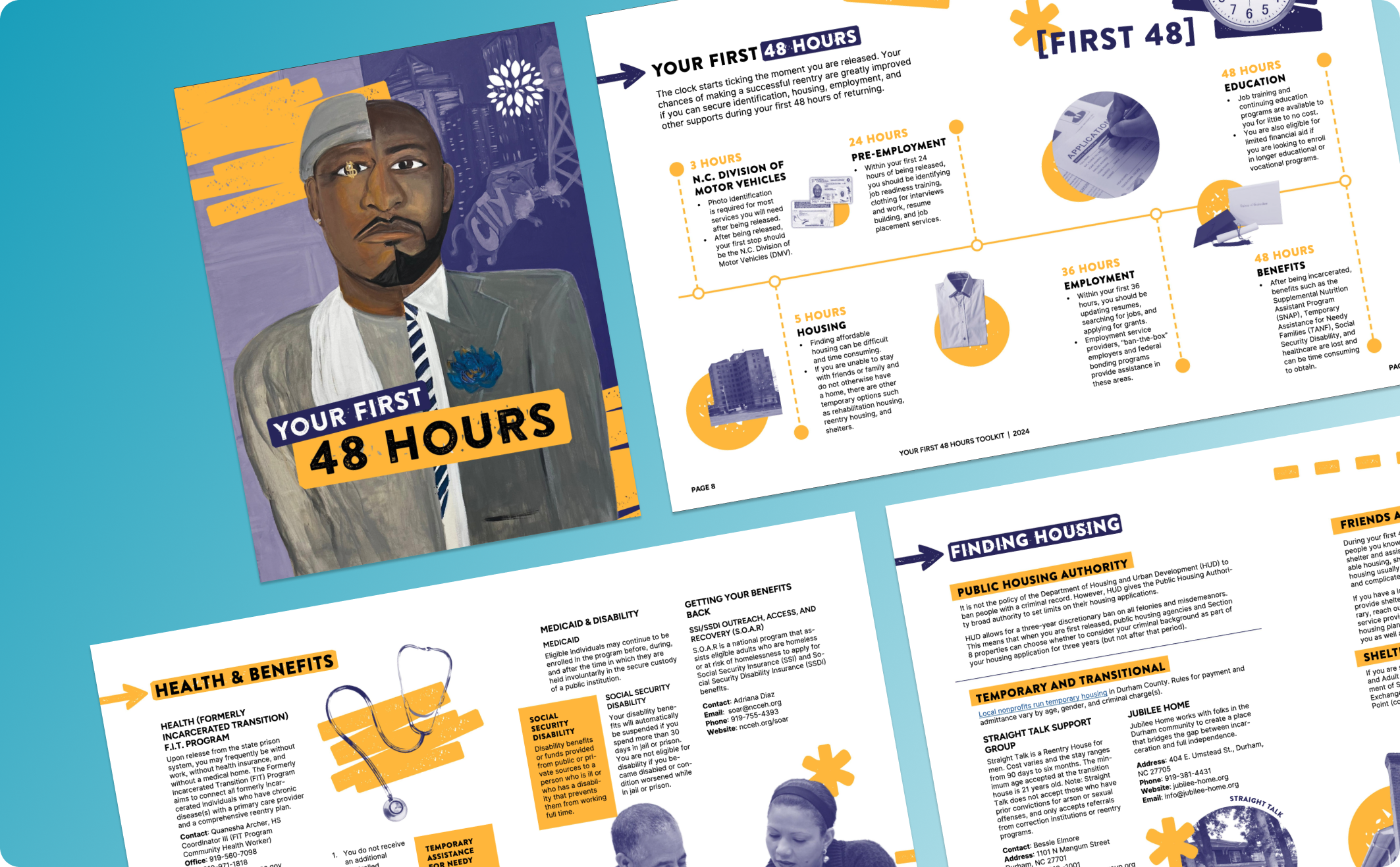
Your First 48 Hours Toolkit
Your First 48 Hours Toolkit is a resource guide for successful reentry after incarceration. It connects people to resources and service providers in the greater Durham area to help them overcome the barriers to reentry.
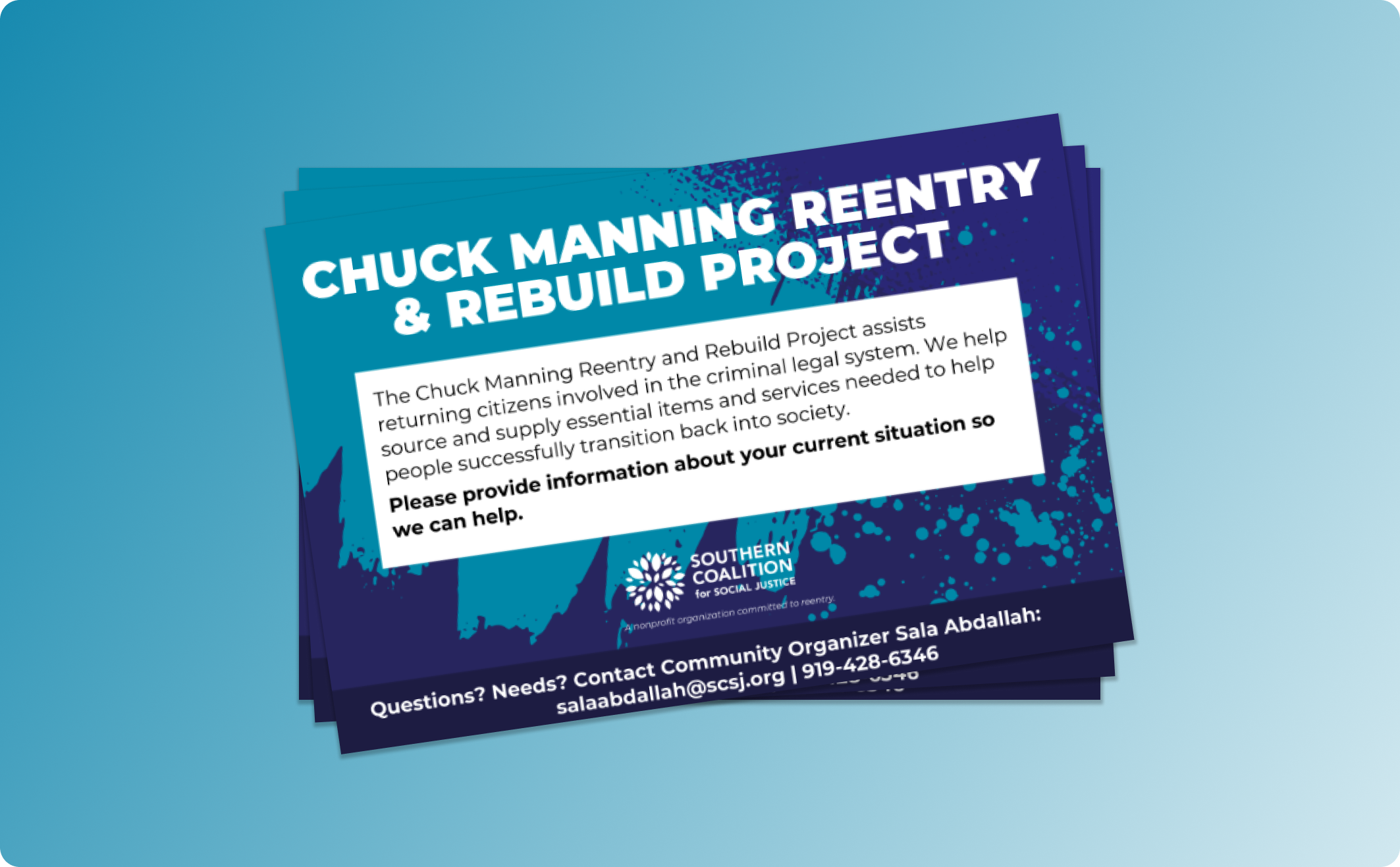
Chuck Manning Reentry & Rebuild Project
The Chuck Manning Reentry & Rebuild Project focuses on bridging the gaps facing those who are, or have been, involved with the criminal legal system by providing direct support to people coming home from incarceration.
Proof of Concept: Robust Reentry Resources Improve Public Safety
Reentry programs play a significant role in helping formerly incarcerated individuals navigate the challenges of reentering society, contributing to lower crime rates, higher success, and stronger communities.
In 2024, Virginia Governor Glenn Youngkin (Rep.) launched an initiative to incentivize state government, nonprofits, and other stakeholders to work together to ensure returning citizens have access to jobs, housing, healthcare, and mental health treatment. After only four months, the pilot program had already helped 3,000 returning citizens find a job and 7,000 access healthcare.
South Carolina’s Second Chance Program, a partnership between the South Carolina Department of Corrections and the South Carolina Department of Employment and Workforce, focuses on reducing the recidivism rate and helping employers in the state. Returning citizens are taught the skills to gain employment and obtain financial autonomy. Because of reentry programs like this, South Carolina has reduced its recidivism rate by 44% in the past 15 years.
Alabama’s Reentry Program was named the finalist for the National Innovation Award. The program provides mental health assistance, substance use disorder treatment, education, and workforce readiness services to returning citizens. During the first two years of the program, 270 individuals on probation and parole graduated – and none of the graduates of the Prison Re-Entry Program have reoffended.
The More You Know
A small but hopefully growing number of formerly incarcerated and directly impacted people are also running for public office, bringing their lived experiences and expertise into the legislative and policy space. For example, in January 2024, Don Scott became Virginia’s first Black speaker of the house in the commonwealth’s 400 year history. Mr. Scott previously served seven years in prison on federal drug charges. Since 2020, a handful of other people with direct experience with the criminal legal system have been sworn into public office, including Cherie Cruz (Rhode Island legislature), Leonela Felix (Rhode Island legislature) Eddie Gibbs (New York legislature), and Tarra Simmons (Washington legislature). In December 2023, Tiawana Brown became the first formerly incarcerated person to serve on the Charlotte (NC) City Council.
External Resources

The Recidivism Reduction Hotline
This toll-free hotline (888-852-0004) provides information and referrals for employment, housing, healthcare, and public benefits services for people in North Carolina coming home from jail or prison.
NCWorks Career Centers
Located across the state, these centers help job seekers find employment, improve their skills, and connect them with additional resources to prepare for job interviews.
OurJourney Forward Together
This organization was created by a group of formerly incarcerated people, and it provides reentry kits and resource guides to help with transitional housing, and other resources for people coming home from prison.