

North Carolina's Jail Population Explodes Following Passage of Iryna's Law
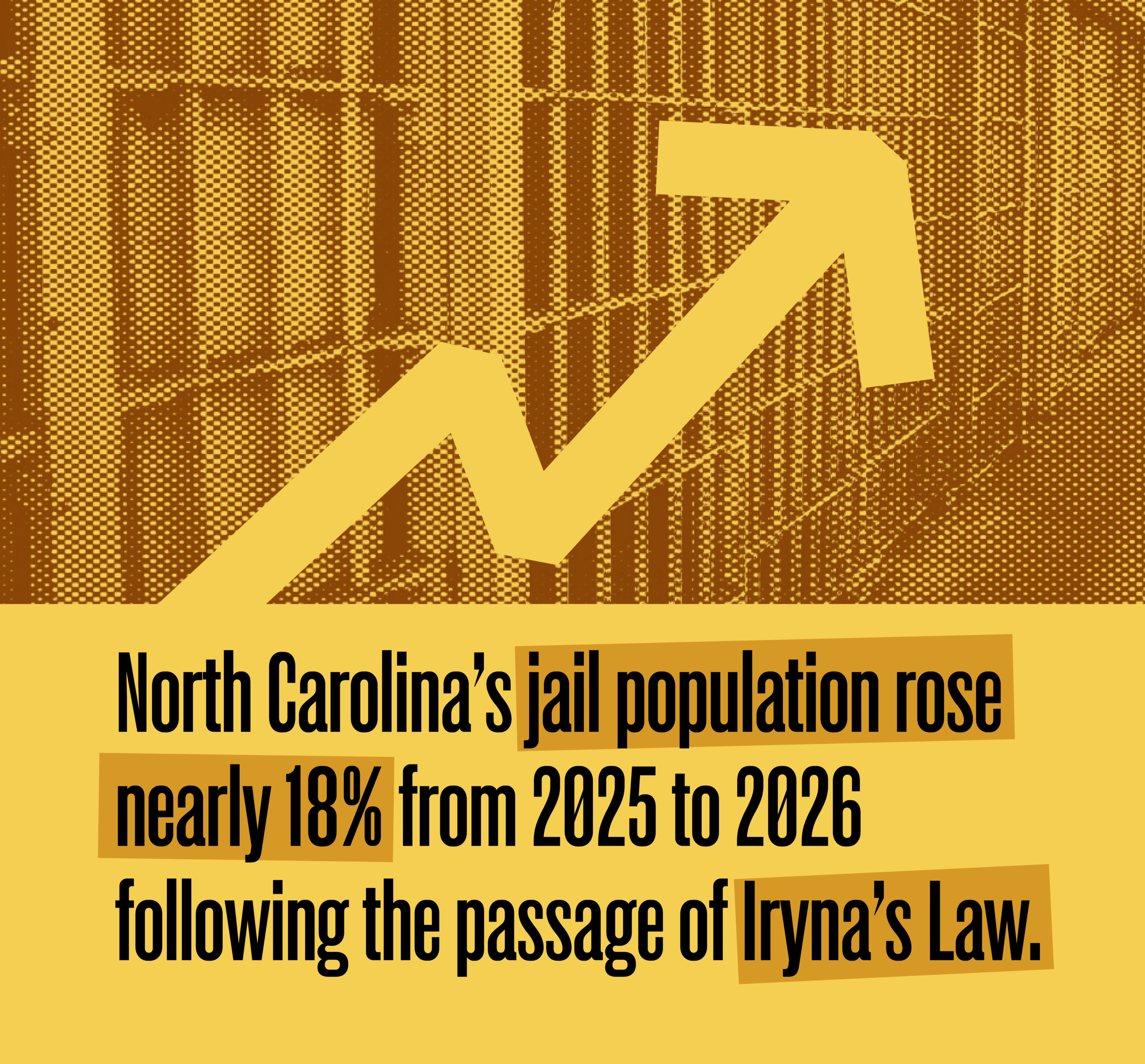
New analysis of local jail data shows that North Carolina’s jail population rose nearly 18% from 2025 to 2026 following the passage of Iryna’s Law. This is the largest annual increase in the jail population in the four decades since data on the statewide jail population was first collected, and more than one-third of jails are now operating dangerously above their capacity.
Background
Following the killing of Iryna Zarutska, a 23-year-old Ukrainian refugee, on the Charlotte light rail last summer, the North Carolina General Assembly passed sweeping changes to the state’s pretrial system as part of Iryna’s Law, also known as House Bill 307. Legislators moved the bill through multiple committees and floor votes in just two days with almost no public debate, and Gov. Josh Stein signed it into law on Oct. 3, 2025.
The law, most of which, went into effect on Dec. 1, 2025, dramatically restricts pretrial release by narrowing the options available to court magistrates and judges. While the law directs a state research funding agency to study “[t]he intersection of mental health and the justice system,” the issue at the heart of Zarutska’s death, the legislation itself focuses on limiting judicial discretion and keeping people in jail before their trial unless they can afford to pay cash bail for their freedom.
Key policy changes in Iryna’s Law:
Requires cash bail as a condition of pretrial release in more cases.
State law previously expressed a preference for non-financial conditions of release for most low-level charges, including nonviolent misdemeanors and felonies, but the new law eliminates written promises to appear, requiring an unsecured bond, secured bond (i.e., cash bail), or custody release (i.e., house arrest) depending on the specifics of the case (see more below).
Eliminates unsecured bonds and custody releases as a condition for release if the person has had three or more convictions.
Regardless of their current charge, a person now has to pay cash bail for their release if they have three or more prior convictions, including misdemeanor offenses, in the past 10 years. The legislation does not explicitly require the court to inquire of the person’s ability to pay.
Creates a rebuttable presumption against pretrial release for someone charged with a newly defined “violent offense.”
Regardless of any other factor, if someone is charged with an offense on a new list of “violent” crimes defined in G.S. 15A-531(9), they will be held pretrial without bond. (This list includes some offenses that do not involve physical violence, like burglary of an unoccupied dwelling, unlawful possession of a firearm, misdemeanor stalking, and fentanyl trafficking.) While the presumption of detention is rebuttable, the law does not provide a standard for the courts to apply, nor does it provide a lawyer for the person during either their initial appearance before a magistrate or first appearance before a district court judge. If and when the presumption is overcome, the person can only be released on a secured bond or house arrest if the court provides a written finding of why those conditions are appropriate.
Requires the court to consider a person’s prior arrests regardless of whether they were dismissed.
This change requires judges to consider not just prior convictions but also prior arrests that led to charges which have been dismissed or rejected by a jury.
These changes all push in the same direction: more people being held in jail for longer periods of time before their day in court. The remainder of this brief delves into the early impact of the law.
Data Findings
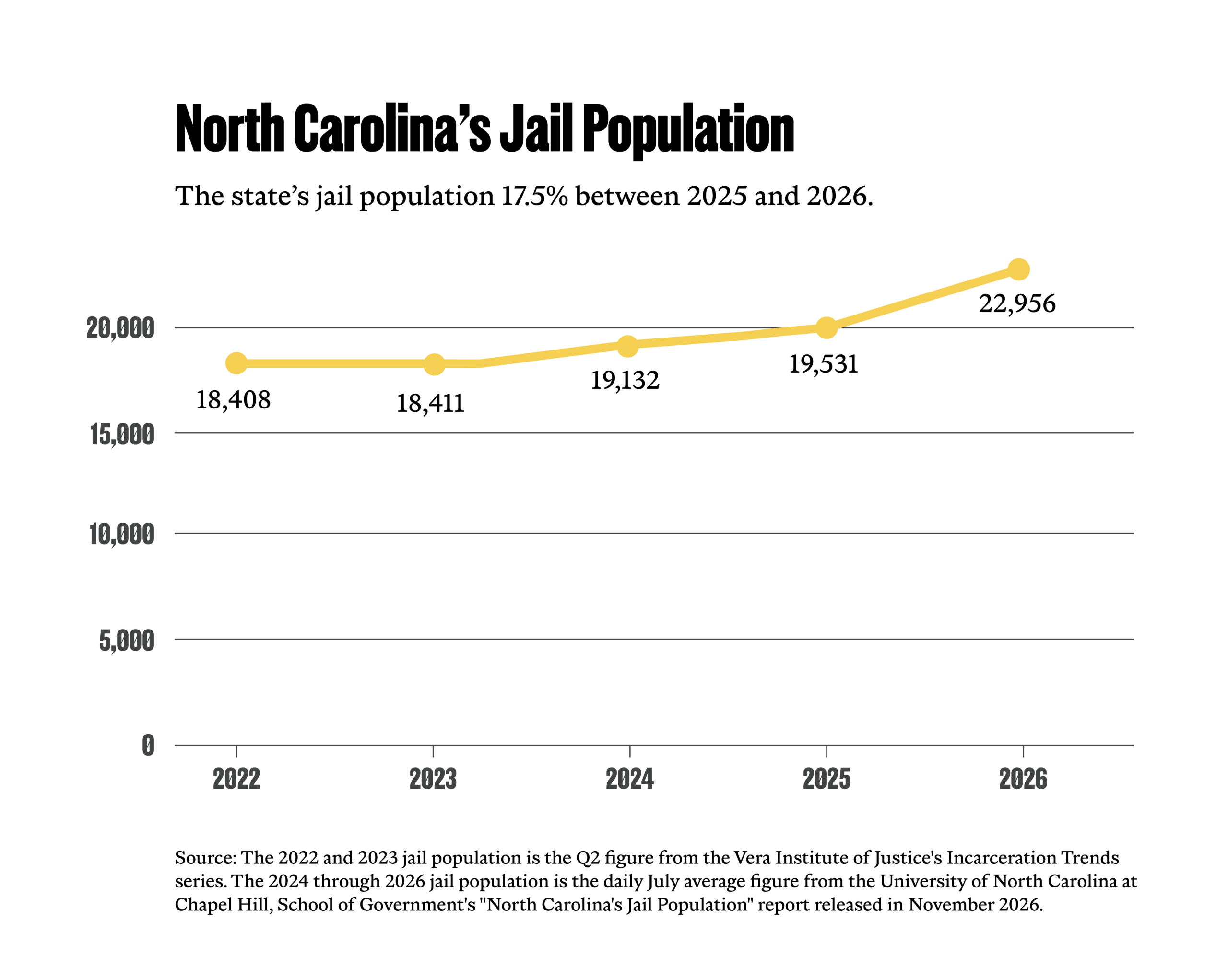
North Carolina’s statewide jail population rose nearly 18% from 2025 to 2026.
Jails across the state of North Carolina held an average of 22,956 people in July 2026, up from 19,531 the previous year. This increase of more than 3,400 people represents 17.5% growth in the statewide jail population. The jail population has surpassed its previous peak of 20,726 set in 2019 before the pandemic and now sits at an all-time high.
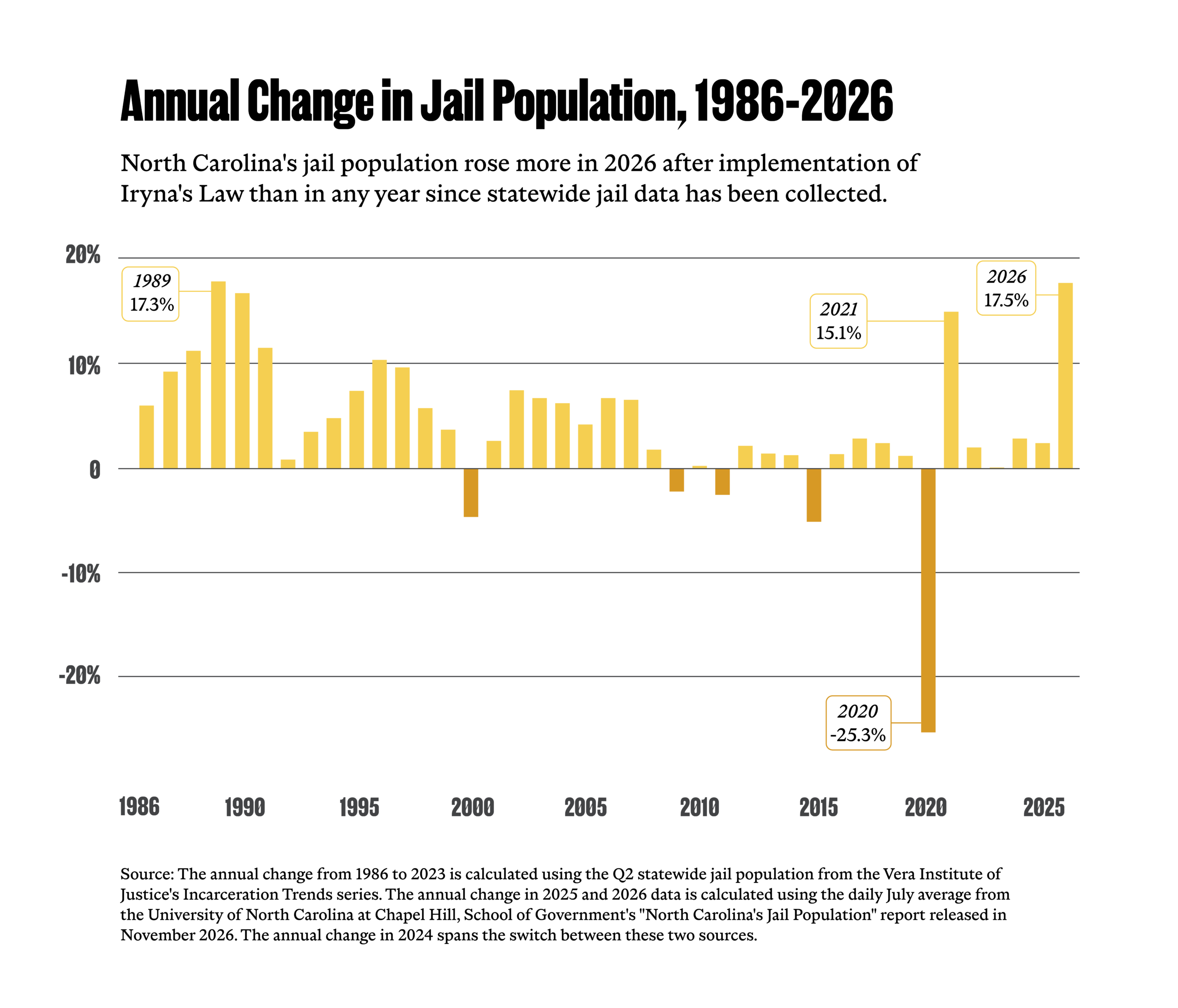
The increase in the jail population is the largest since statewide jail data began being collected in 1986.
Less than one year into the new law, North Carolina’s jail population has already risen faster than in any year since statewide data began being collected. The 17.5% increase from 2025 to 2026 is larger than the increases during the failed “tough on crime” era of the 1980s and 1990s, as well as 2021 when the jail population rebounded from the COVID-era declines.
More than half of North Carolina’s jails are at or above their capacity.
During the first half of 2026, 38 of the 98 jail facilities reporting data to the Department of Health and Human Services were operating above their capacity, up from 31 during the same time period last year. Scotland, Warren, Chowan, Greene, and Halifax counties have the most severe overcrowding in the state, with their jails ranging from 153% to 178% of capacity. Another 15 jails are approaching capacity and will likely be over capacity in the near future if these trends continue.
Crime was declining before Iryna’s Law and has continued to fall to record lows.
North Carolina, like the rest of the country, experienced declining and historically low crime rates in the years before the passage of Iryna’s Law. According to data from the FBI, the state’s violent crime rate declined 7.2% between 2022 and 2024 and fell another 12.9% in 2025. Meanwhile, data from the Crime Index indicates that North Carolina’s property crime rate hit a 50-year low in 2024 and declined still further in 2025 in the cities and counties from which it draws its sample. North Carolina Department of Public Safety data from the first half of 2026 indicates that these trends continue, with violent crime falling by another 5.8% and property crime by 11.9%.
There is no statewide arrest data available for 2026, but information from Charlotte and Raleigh provide a sense of the trends in the state’s most populous areas. In Charlotte, arrests in June 2026 were 8.2% higher than June 2025 but remain significantly lower than in 2021-22. In Raleigh, arrests declined by 14.9% between June 2025 and June 2026.
At the same time that North Carolina is experiencing historically low crime rates, its jail population is reaching historic highs. One trend cannot explain the other, as crime was falling before Iryna’s Law began driving the jail population upward and has continued falling since, in line with crime trends in the rest of the country. Arrests also don’t seem to be causing the jail population increase, as their trends don’t track with that of the jail population in the state’s two largest cities.
View from the Counties
Since the passage of Iryna’s Law, some sheriffs and district attorneys across the state have spoken out about how the changes are driving increases to their jail populations and straining capacity. Data from Buncombe County shows that the number of people in jail pretrial for a misdemeanor charge has risen rapidly over the past year, with the sharpest increases for the least serious misdemeanor charges.
Overall, bookings for misdemeanor charges rose 25% from May 2025 to May 2026 in Buncombe County. The amount of time people are spending in jail has also been rising, and the jail population has increased 17% over the same time period as a result. County officials attribute these increases to the changes in Iryna’s Law, warning of jail overcrowding that is putting the safety of incarcerated people and staff in jeopardy.
Other counties are also experiencing significant overcrowding as a result of the policy changes in Iryna’s Law. Mecklenburg County has seen its population increase 32% since the law took effect and the county is reopening a facility that had previously closed. In Wake County, the jail population also now exceeds capacity, driven by a 114% increase in the number of people held pretrial without bond. While additional research is needed to identify which of the policy changes in Iryna’s Law are driving these increases, it’s clear that the law is leading to more people being held in jail pretrial, many of whom have been charged with low-level misdemeanors.
Conclusion
One year after the General Assembly passed Iryna’s Law, North Carolina’s jail population has hit an all-time high, leaving facilities across the state dangerously overcrowded. This rapid expansion represents the largest single-year increase in the jail population since statewide jail data began being collected in 1986, the height of the failed “tough on crime” era that led to so many harmful consequences for families and communities across our state.
There are common-sense changes to Iryna’s Law that policymakers should consider to alleviate the pressure the law is putting on local jails and reduce the number of people who are being unnecessarily incarcerated just because they can’t afford cash bail. If the state does not act, the jail population will continue to rise and more local jails will buckle under the pressure of a law that was hastily passed without proper debate about the effect it would have.
About the Data
The data used in this brief comes from three primary sources: the North Carolina Department of Health and Human Services (DHHS) via Disability Rights North Carolina (DRNC), The University of North Carolina at Chapel Hill, School of Government’s “North Carolina Jail Populations” report authored by David L. Rosen, Evan A. Ashkin, and Ted R. Zarza in November 2026, and the Vera Institute of Justice's Incarceration Trends series.
DHHS’s Division of Health Service Regulation collects the average monthly population for every jail in the state, along with that jail’s design capacity. DRNC obtains this data via regular public records requests and shared data from January 2022-August 2026 with SCSJ for the purposes of this analysis. Those data were used to calculate the jail capacity estimates by dividing the highest reported population between January and June of each year by the capacity of that facility.
The same DHHS data was used by the UNC-CH School of Government for its report. The July comparison is important since Zarutska’s murder happened in August 2025, which may have impacted pretrial decisionmaking even before Iryna’s Law took effect in December 2025.
The Vera Institute of Justice publishes statewide jail population numbers for North Carolina in its Incarceration Trends database. We used the 2nd quarter population number for each of the years before 2024 to calculate the annual change in the state’s jail population.